Akshay Cadambi
Title: Adding modulation and control to MSynth
This project attempted to add the basics of control and modulation into MSynth. MSynth was developed as a simple and easy to use library for producing interesting sounds on the Arduino. It can now do amplitude modulation and ring modulation along with a rudimentary attack/decay envelope.
Matthias Wagner
Title: Orko MultiShifter Plugin
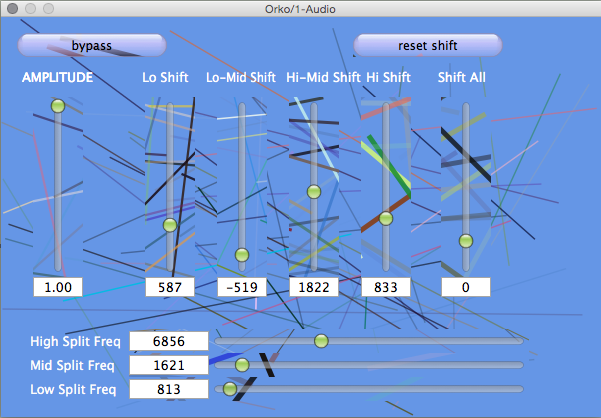
The incoming signal is split into 4 frequency bands via Linkwitz-Riley crossover filters, where the crossover frequencies between the bands can be adjusted. Each band's frequency can be independently shifted up or down, or all 4 bands can be shifted by the same amount. Frequency shifting is achieved through single side amplitude modulation with a Hilbert filter and sine / cosine modulators. The plugin was implemented using the JUCE framework.
Source available upon request.
Nathan Weitzner
Title: OSCSender
This project sends sensor data from a smartphone to a computer. The smartphone application contains a view for each of the following sensors: accelerometer, gyroscope, and magnetometer. An additional view has several graphical sliders. The computer runs an application with three sinusoidal oscillators where the frequency of each is controlled by the incoming data.
Lecturer: Andrés Cabrera andres@mat.ucsb.edu
Room: Elings 2003
TA: Joseph Tilbian
Quarter: Spring 2015
Mailing list: http://lists.create.ucsb.edu/mailman/listinfo/240
Summary
These are the websites for other courses for the 240 series: