| |
|
|
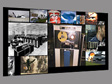 |
2 screen installation view in corner
|
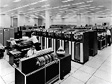 |
Configuration 1
|
 |
Configuration 2
|
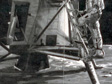 |
Configuration 3
|
 |
Configuration 4
|
|
|
Studies in ReTelling, 2009
Custom software for screen or projection,
dimensions variable
"ReTelling" is a computer generated animation that continuously re-positions images in scale and location to create each time a different visual composition. It is inspired in part by the OULIPO author Raymond Queneau's mutiple retelling of a simple story to demonstrate how stylistic changes impose meaning. This version of "Retelling" features two sets of images, one color, the other black and white that replace each other over time, resulting in the story's meaning potentially altered.
The reconstruction of narratives based on the rearrangement of a story's basic elements have been a principal theme in 20th Century literature, cinema and art. Examples include the montage of Eisenstein, Resnais and Robbe-Grillets "Last Year in Marienbad", Chris Markers "La Jetée" and others. The artist Brion Gysin and writer William Burroughs "cut-up" technique in the 1950s consisted of an aleatory process in which a text cut-up into smaller pieces were rearranged randomly to create a new text.
Time-based reconstruction is one of the fundamental principles of interactive art. Software artist/engineer Angus Forbes collaborated with the artist to finetune a mathematical model used in the study of probability and statistics applied to the problem of how to best organize a set of objects of various sizes into a finite physical space such as a container. The "ReTelling" project explores the potential of such an engineering study as a form for expression in storytelling.
| |
|
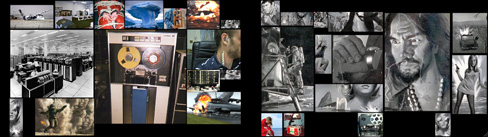 |
The configuration of images continuously re-organize themselves in size and location over time, thereby reformulating the narrative outcome of their juxtapositions. In a two-screen presentation, images from each screen migrate over time to the opposite screens, disturbing each others' coherence. [Click here to view the video] |
|
A George Legrady project, with software engineering and design by Angus Forbes.
|
|
|
|
;)
;)
;)
;)
;)